Teachers are the backbone of public education, yet more and more are choosing to step away. Understanding why they leave, and what might bring them back, is crucial for school leaders, districts, and communities hoping to maintain quality learning.
Key Data & Trends
- A RAND study reports that teacher turnover rose sharply during the pandemic (peaking at about 10% in some districts), but as of the 2023-24 school year it has cooled to about 7%, still slightly higher than pre-pandemic levels (~6%). RAND Corporation
- According to the NCES, about 8% of public school teachers left the profession between the 2020-21 and 2021-22 school years. That rate is similar to what was seen even in 2011-12, despite all the extra pandemic-related stress.
- In California, a survey found that 4 in 10 teachers are considering quitting. Low pay and lack of school resources are major causes. California Teachers Association
- In Texas, after a decade of relative stability, Texas Education Agency reports, Texas now faces a teacher attrition crisis, over one in five educators left the profession in 2023–24.
Top Reasons Teachers Say They’re Leaving
This is not a future problem, it is a current and accelerating reality. Schools across the country are being forced to fill vacancies with underprepared educators, consolidate classrooms, or eliminate essential programs. The result is a vicious cycle: poor conditions lead to attrition, which leads to increased strain on the remaining staff, which then leads to even more attrition.
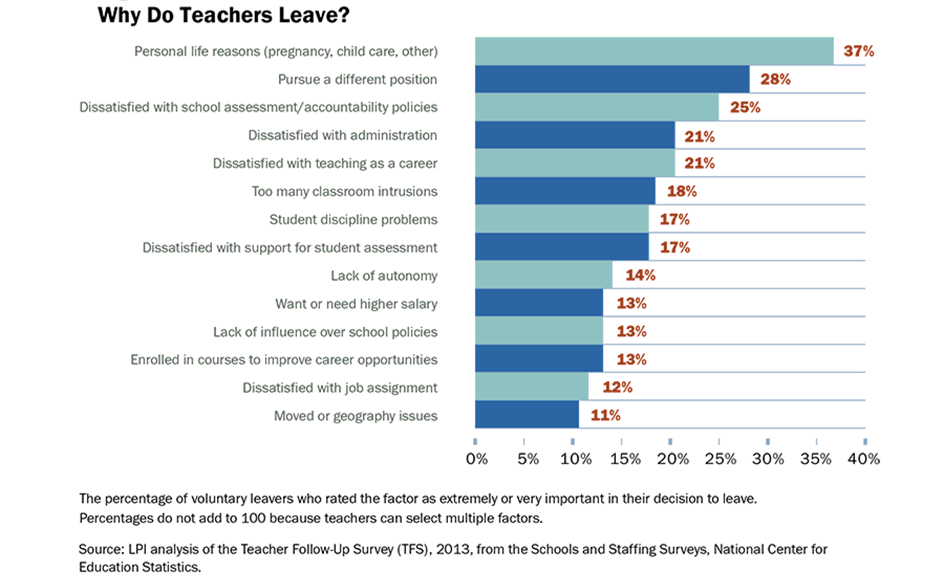
Based on multiple studies and surveys, here are the primary factors driving teacher exit:
- Burnout, Stress & Mental Exhaustion
The pandemic didn’t invent burnout—but it made it worse. Teachers often report feeling overwhelmed because of increased work hours, remote or hybrid instruction, adapting to changing modes of teaching, and emotional demands in the classroom. Economic Policy Institute+3National Education Association+3RAND Corporation+3 - Lack of Administrative Support & Autonomy
Teachers frequently say they don’t feel supported by their school leadership, especially when it comes to discipline, student behavior problems, curriculum mandates, and being told what to do without input. Many wish they had more control over their classrooms. KCUR Economic Policy Institute - Inadequate Compensation & Cost of Living
Salaries for teachers have struggled to keep up with inflation, and in many areas, housing, healthcare, and other living costs make it hard to stay on the profession. Low pay is repeatedly named as a top reason. Economic Policy Institute - Challenging Working Conditions
This includes large class sizes, lack of supplies or resources, deteriorating physical environments, safety concerns, and insufficient support for student behavior and mental health issues. Aspen Times - Personal Life & Work-Life Balance
Many teachers leave due to health, family obligations, childcare, or simply needing a break. Also, many report that their work spills over after hours in planning, grading, parent communication, etc. National Center for Education Statistics
Consequences & Impacts
- Student learning suffers when there’s turnover. New or substitute teachers may have less experience or training, which can affect continuity, quality of instruction, and student outcomes.
- Costs go up for districts: recruiting, hiring, onboarding, training replacements, all of this adds expense.
- Morale erodes. Remaining teachers feel more burdened, which can lead to more leaving, a vicious cycle.
- Achievement Gaps Increase. Schools in lower-income neighborhoods often have higher turnover, fewer resources, and more difficulty attracting replacements. This deepens achievement gaps.
What might we do different?
Here are some interventions that research suggests could make a difference:
- Improving administrative and emotional support for teachers. Leadership that listens, includes teacher voice, and offers flexibility helps.
- Competitive pay, benefits, and incentives that reflect the demands and expertise of the job.
- Reducing workload: fewer non-teaching tasks, better planning time, fewer mandatory meetings that aren’t meaningful.
- Improving student behavior support and mental health services in schools. Teachers often cite classroom management stress as a top reason for considering leaving.
- Recognizing and rewarding excellence and providing professional growth opportunities.
What School Leaders & Districts Can Do
- Conduct surveys or listening sessions with teachers to understand local conditions and pain points.
- Audit compensation, resource allocation, supports (counselors, special ed, behavior specialists) to see where gaps are.
- Build structures for peer mentorship, coaching, teacher leadership roles to boost teacher retention and satisfaction.
- Prioritize consistent policies, predictable schedules, and clear communication. Uncertainty and frequent changes can be demoralizing.
Teachers are leaving because teaching has become unsustainably hard. If districts, leaders, and communities want to reverse this trend, we must take targeted actions now. Supporting our educators isn’t optional, it’s fundamental to achieving high-quality education for every student.
Sources
- Educator Turnover Continues Decline Toward Prepandemic Levels: Findings from the American School District Panel (RAND) RAND Corporation
- Eight Percent of Public School Teachers Left Teaching in 2021 (NCES) National Center for Education Statistics
- State of California’s Public Schools: Educator Turnover & Intent to Leave (CTA & GBAO Strategies) California Teachers Association
- Why are teachers leaving?: Survey data from Missouri KCUR
- Why Colorado Teachers Are Leaving: Low Pay, High Stress, and Safety Concerns Aspen Times
 EverNorth Education
Leave a comment